 Dávid Juhász
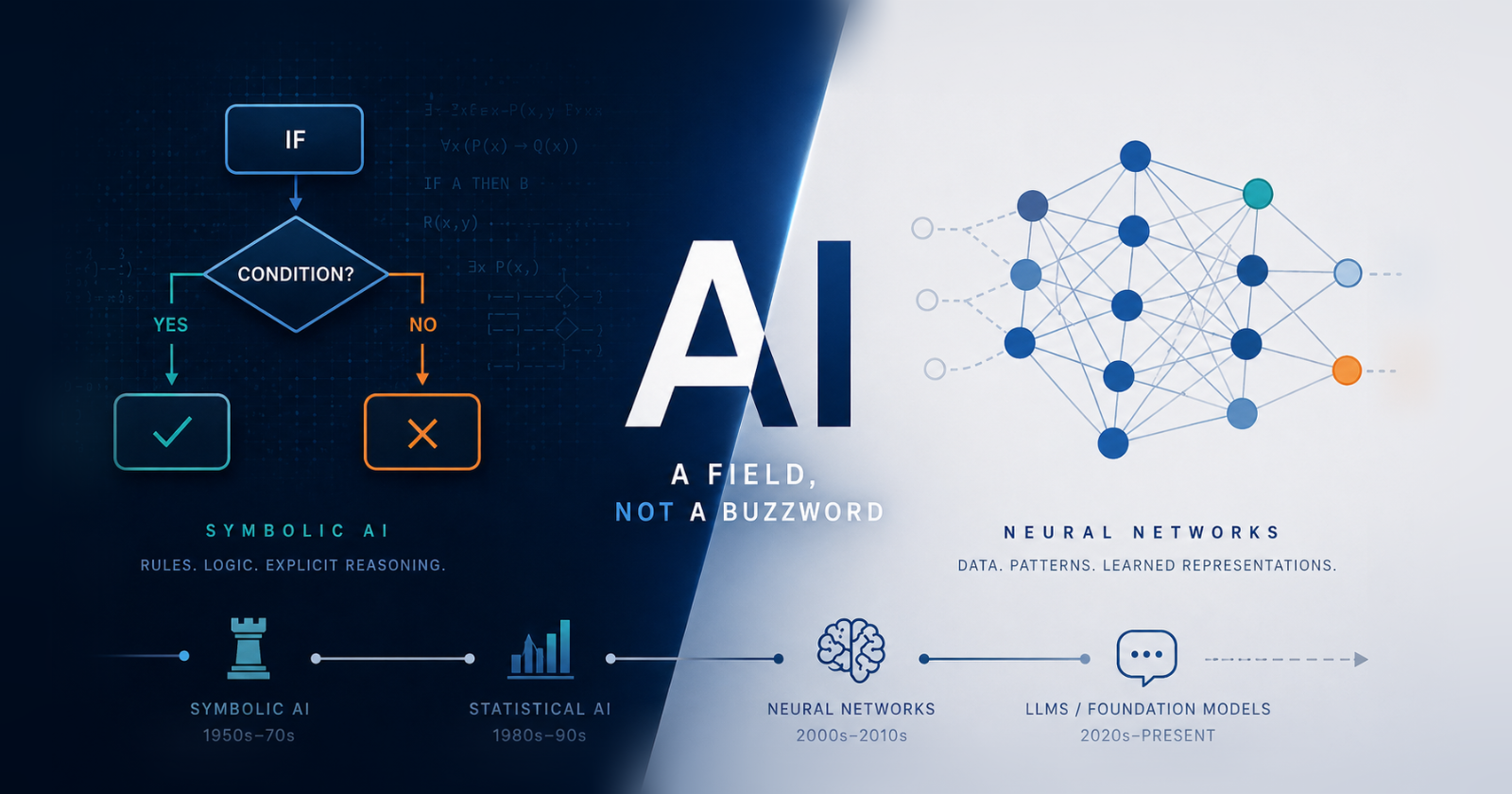
Artificial Intelligence (AI) is everywhere — but what even is AI? Behind the buzzword lies a diverse field: symbolic systems, statistical models, neural networks, each with distinct strengths and trade-offs. This post cuts through the hype to explain the field's diverse techniques, historical roots, and why engineers need to know the difference.
AI Is Not a Monolith
AI is often sold as a singular, revolutionary force — a cure-all for complex problems. It's not.
AI is a diverse field composed of techniques, methodologies, and applications. From rule-based systems to statistical models, Bayesian networks, evolutionary algorithms, and neural networks, AI encompasses a spectrum of approaches, each suited to different problems.
The Field: A Spectrum of Techniques
At its core, AI is the study of creating systems that can perform tasks typically requiring human intelligence: reasoning, learning, perception, and decision-making. Yet, "AI" has become a catch-all, obscuring the lines between its subfields.
To make sense of this, think of AI not as a single thing but as a layered field:
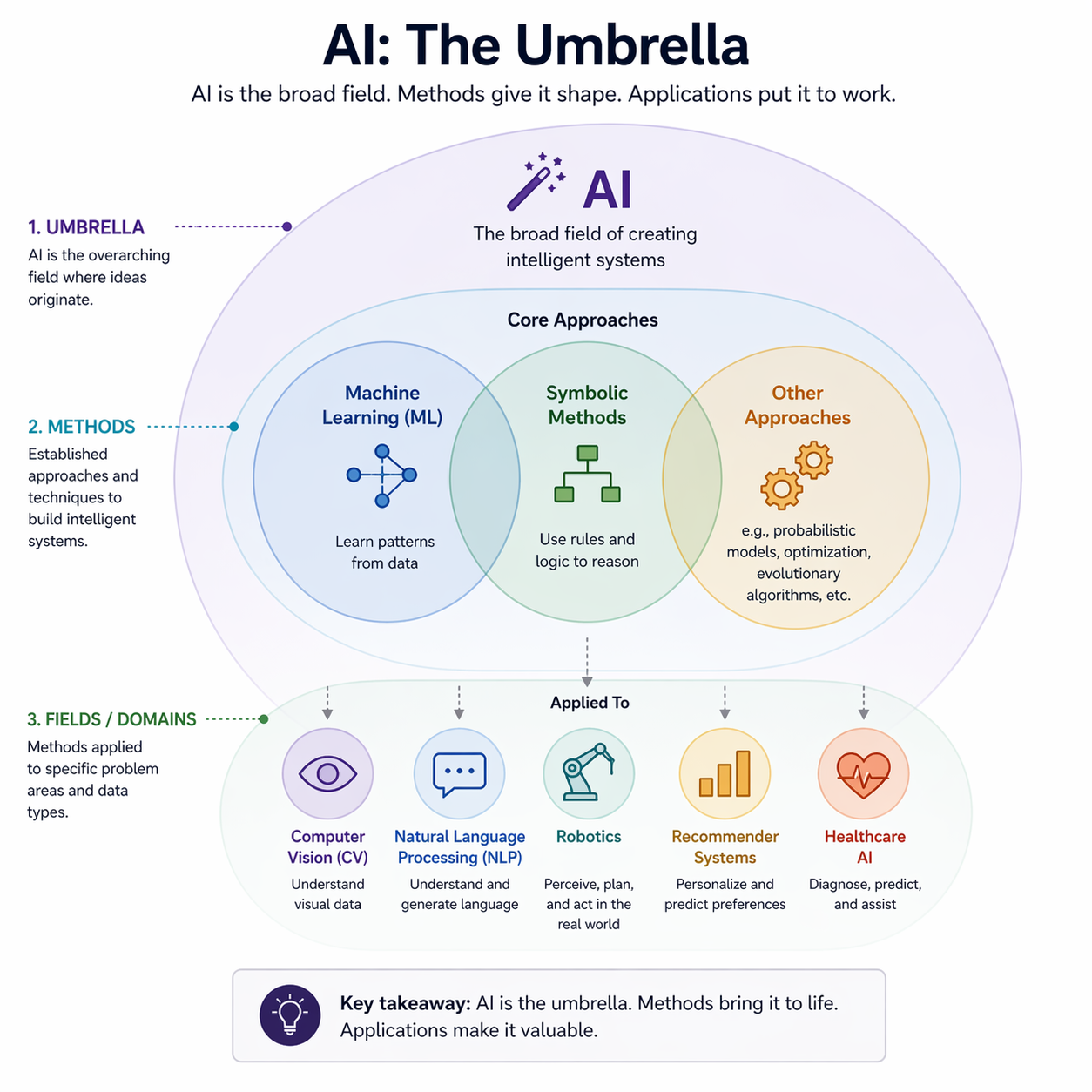
For engineers and technical leaders, understanding AI as a field — rather than a single tool — is crucial. It enables informed decisions about which techniques to apply. Whether leveraging symbolic AI for rule-based decision-making or deploying neural networks for pattern recognition, recognizing AI's diversity is the first step toward building effective, intelligent systems.
Historical Roots: From Dartmouth to Deep Learning
The term "Artificial Intelligence" emerged in 1956 at the Dartmouth Conference, where researchers envisioned machines simulating human intelligence. Since then, AI has evolved through multiple waves, each with distinct approaches and ambitions.
Early AI was dominated by symbolic AI, which relied on explicit rules and logic. These systems were transparent and interpretable, but struggled with adaptability and uncertainty.
The 1980s and 1990s marked a shift toward statistical methods, as researchers explored models that learned patterns from data rather than relying on pre-programmed rules. This period saw the revival of connectionist models, including Artificial Neural Networks (ANNs), with advancements like backpropagation and multi-layer architectures. While these models laid the groundwork for modern machine learning, their practical impact was limited by the computational power and data availability of the time.
The true breakthrough for ANNs — especially in image processing — came later, with AlexNet in 2012. This deep learning model demonstrated the power of Convolutional Neural Networks (CNNs) on large-scale datasets, revolutionizing the field. This milestone underscores AI's diversity: each breakthrough solved a specific problem, not "intelligence" as a whole.
Today, "AI" is often used interchangeably with machine learning models, particularly deep learning and neural networks, which dominate headlines. This narrow focus overshadows the broader field, fostering misconceptions. While neural networks excel in areas like image recognition or natural language processing, they are just one tool in the AI toolkit.
Understanding AI's historical context clarifies these misconceptions. It underscores the importance of viewing AI as a diverse toolkit of techniques, not a monolithic solution. This perspective is essential for leveraging AI effectively, without falling prey to hype or oversimplification.
From Magic to Mainstream: AI's Evolution
Artificial Intelligence often feels like magic — especially when it performs tasks that seem to require human-like intuition or reasoning. This perception isn't just a side effect of AI's complexity, but a product of how the field evolved from niche research to everyday tools.
The Illusion of Intelligence
Early AI victories, like IBM's Deep Blue defeating Garry Kasparov in 1997, relied on rule-based, expert systems — not the statistical models we associate with AI today. Yet even these systems were labeled "intelligent," fueling the hype that still clouds the field.
How could a machine outmaneuver a human in a game of strategy? The answer isn't magic — it's method. Early AI followed explicit rules; today's systems, particularly machine learning, excel at finding patterns in data. They recognize statistical correlations and optimize performance through feedback. The results may impress, but they don't imply understanding. The illusion fades when we see AI for what it is: a tool for pattern recognition and optimization.
This misunderstanding persists because AI's inner workings are often opaque. Neural networks, for example, are "black boxes": inputs go in, outputs come out, but the intermediate steps are difficult to interpret. This opacity fuels the mystique, but it also highlights a critical point: AI's power comes from its ability to process and learn from data, not from any inherent intelligence.
How AI Became Everywhere (and Everywhere Became AI)
AI's journey from laboratory curiosity to mainstream technology is a story of evolution and specialization. In its early days, AI was a broad, ambitious field aiming to replicate human intelligence. Researchers explored symbolic reasoning, expert systems, and even early neural networks. However, progress was slow, and expectations often outpaced reality.
The turning point came with the rise of Machine Learning (ML) and Computer Vision (CV). These subfields focused on solving specific, practical problems — like recognizing handwritten digits or classifying images — rather than pursuing general intelligence. For years, AI quietly powered tools like recommendation systems, fraud detection algorithms, and driving assistants, augmenting human capabilities behind the scenes. These applications demonstrated AI's potential long before it became a household term.
The arrival of Large Language Models (LLMs) in the 2020s thrust AI into the spotlight — for better and worse. Tools like ChatGPT transformed AI from an invisible enabler to a visible, interactive force.
Today, when people say "AI," they often mean generative AI — systems capable of producing human-like text, images, or even code. This transition from specialized applications to broad, conversational interfaces has made AI more visible and accessible than ever. However, it has also intensified the confusion around what AI truly is. While LLMs excel at mimicking human communication, they remain statistical models, not sentient beings.
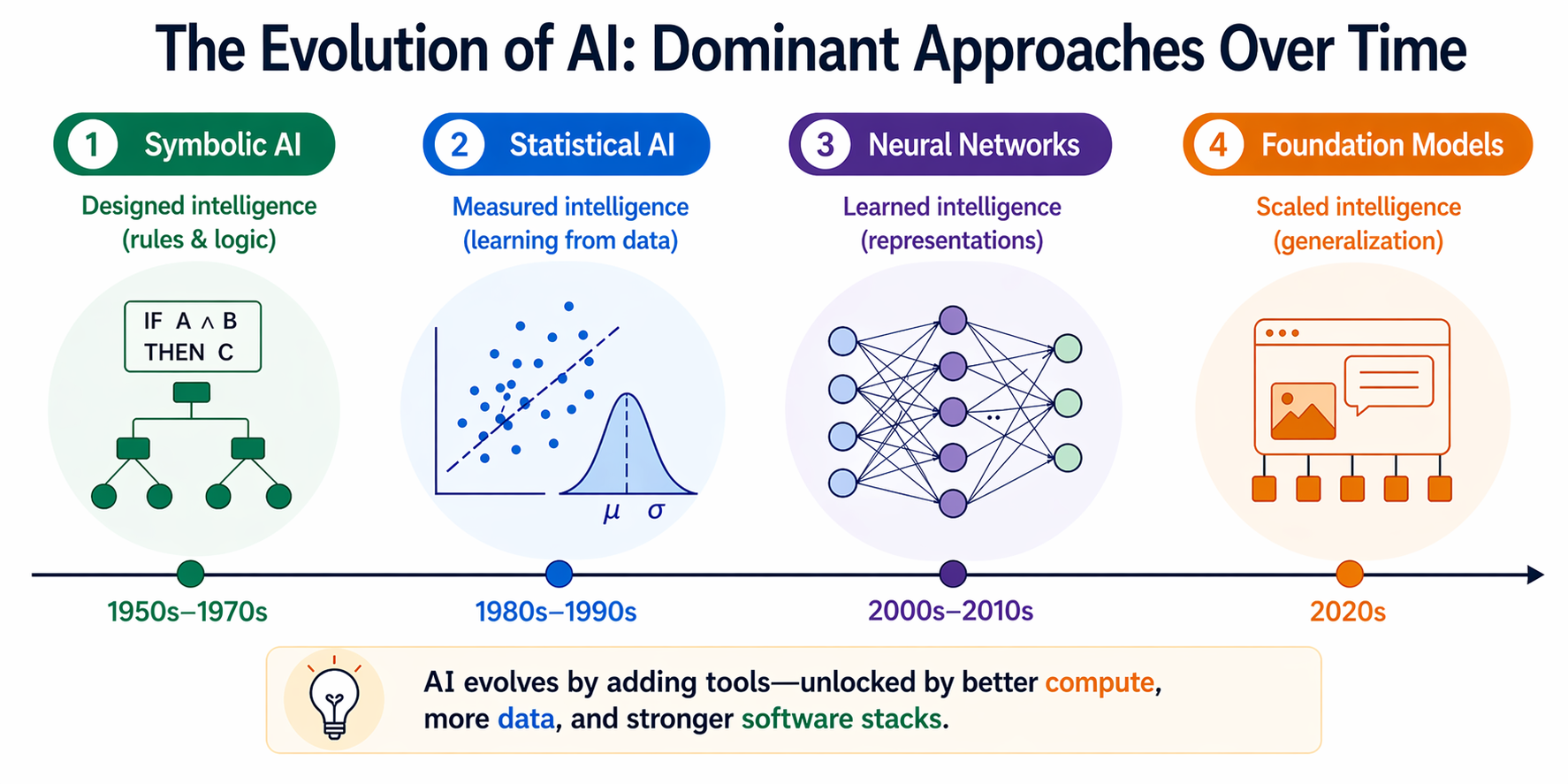
Understanding this evolution helps us appreciate AI's strengths and recognize its boundaries. The term "AI" may now encompass everything from chatbots to self-driving cars, but its core remains rooted in data-driven optimization and practical problem-solving.
Neural Networks: Statistical Engines
As AI evolved from abstract theory to practical tools, ANNs emerged as its most powerful — yet most misunderstood — workhorse. Unlike traditional rule-based systems, ANNs represent a paradigm shift: they don't follow instructions, they learn them.
Why ANNs Aren't Algorithms
Neural networks are often mislabeled as "algorithms," but this conflates two distinct layers: the execution algorithm and the model itself.
The execution — training and inference — is algorithmic. We write precise code to propagate data, compute gradients, and update weights. These steps are deterministic and repeatable, though the results of training are not fully deterministic due to randomness in initialization and data sampling.
The model — the topology and learned weights — isn't an algorithm. It's a statistical approximation, shaped by data. While we control the skeleton (the architecture), the "logic" emerges from statistical optimization, not explicit rules. The model doesn't follow a script. Instead, it adapts to minimize error, which makes its behavior opaque — even if its execution is transparent.
The Black Box Trade-Off
The "black box" label for ANNs stems from this duality: while their execution is transparent, their behavior remains unexplained. They achieve remarkable accuracy — recognizing images, translating languages, or predicting trends — but offer little in the way of interpretability into how or why they arrive at these results. This opacity is especially problematic in high-stakes domains like healthcare or autonomous systems, where explainability — often referred to as Explainable AI (XAI) — is critical.
⚠️ Limitations of Mechanistic Interpretability
Researchers study the mechanics of learning to uncover how models internalize patterns. Yet, as we explore in Part 2, even mechanistic interpretability has limits: it reveals what a model learned, but not why or how to generalize beyond its training data.
The issue isn't just technical; it's inherent to their design. ANNs prioritize performance, trading interpretability for capability. Structures like attention mechanisms or saliency maps add partial explainability, but these are tools to steer the statistical process, not true explanations.
For engineers: ANNs deliver what works, not why. Use them for pattern recognition when data is abundant, but pair them with symbolic systems if transparency is critical.
The AI Marketing Term
"AI" is no longer just a technical term for Artificial Intelligence — it's a brand. The shift from laboratory to marketplace has transformed the word into a powerful, if often misleading, tool for selling everything from chatbots to toasters.
How "AI" Became a Buzzword
The term "AI" has been stretched thin by marketing. In the 1950s, it was a bold vision — machines that could reason, learn, and solve problems. But as computing power grew, so did the hype.
By the 2010s, "AI" became a shorthand for innovation, often slapped onto products regardless of their actual sophistication. Startups and corporations latched onto the term to attract investors and customers, using a vague, general label even when their systems relied on specific, narrow applications. The result? "AI" now signals modernity — not precision. It's a label slapped on everything, reducing a diverse field into a marketable buzzword.
What the Hype Obscures
The marketing of "AI" obscures critical distinctions. It conflates narrow applications with the grand ambition of Artificial General Intelligence (AGI). It hides the limitations of current systems — ANNs, for instance, excel at pattern recognition but lack true understanding or reasoning. Worse, it sidelines alternatives like symbolic AI, which offers transparency and reliability in domains where black-box models fail.
By framing everything as "AI," we lose sight of the tools' unique strengths and trade-offs. Engineers risk choosing the wrong approach for their problems, seduced by the allure of a label rather than the merits of the method.
Symbolic AI: The Unsung Hero
While ANNs dominate modern AI discussions, symbolic AI and rule-based systems remain vital for tasks requiring logic, transparency, and explicit reasoning.
Logic Over Learning
Symbolic AI, rooted in logic and explicit rules, offers a stark contrast to the statistical nature of ANNs. Unlike ANNs — which learn patterns from data — symbolic AI relies on predefined symbols and rules to represent knowledge and perform reasoning.
This approach excels in domains where interpretability, precision, and logical consistency are critical, such as expert systems, formal verification, or rule-based decision-making. While neural networks dominate tasks like image recognition or natural language processing, symbolic AI shines in scenarios requiring transparent, explainable logic. For engineers, this means choosing symbolic AI when the problem demands clarity over pattern recognition, ensuring that decisions are traceable and reproducible.
Real-World Hybrids
In practice, real-world systems often combine symbolic AI and statistical methods to leverage the strengths of both. Symbolic AI provides the logical framework and interpretability, while ANNs handle pattern recognition and adaptability.
Examples include:
Autonomous vehicles: ANNs handle perception; symbolic AI ensures rule-based decision-making.
Healthcare diagnostics: Statistical models analyze medical images; symbolic rules interpret results using clinical guidelines.
Formal verification: Transformers generate candidate proofs; symbolic systems verify them.
This hybrid approach ensures robustness, efficiency, and clarity — proving that the future of AI lies in integration, not exclusivity.
Neurosymbolic AI: Bridging the Gap
The idea of combining neural networks with symbolic reasoning is gaining traction as neurosymbolic AI. For a deeper dive into why agentic systems need ontologies and how neurosymbolic AI can address current limitations, check out this insightful talk from Frank Coyle: Why Agentic Systems Need Ontologies.
AI is a toolkit, not a tool. Use neural networks for patterns, symbolic AI for logic — and always match the method to the problem.
Next: In Part 2, we explore why scaling alone can’t deliver true reasoning and what might.